
CITICINEMAS - MAY 22
Increasing Ticket Sales by Improving the User Experience
Reduce Friction, Increase Registrations, and Improve Performance in the Purchase Flow.


| Organization: | Coppel |
| Platforms: | Web · iOS · Android |
| Scale: | +65 product designers and multiple development teams |
| My role: | Principal of Foundations / Design Systems |
| Project time: | 2022 – 2026 |
Coppel is an enterprise organization operating multiple digital products across web and mobile platforms, where more than 65 product designers collaborate with multiple development teams in parallel.
When I joined, there was an initial design system created by an external vendor. While functional, it lacked adoption, governance, and the structural capacity to scale at the pace of the business. In parallel, the organization was entering a corporate rebrand and a deep technological transformation.
As Principal of Foundations, my responsibility was to define an evolution strategy for the design system that allowed foundations to scale safely, without disrupting active products or introducing regressions during a critical period of change.
The organization faced three forces at the same time:
The main risk was not visual. It was organizational. Breaking operational continuity or slowing long term evolution.
Instead of replacing the existing system, Coltrane was structured into two complementary layers, with an intentional transition step.
This approach reduced organizational risk by separating visual adaptation from structural change, enabling progressive adoption without breaking active products.
One of the most critical changes was the redefinition of foundations and tokens.
Foundations evolved from a collection of styles into a decision framework that enabled consistent choices across teams and platforms. The legacy theme adapter solved short term visual alignment, while Bubble addressed the long term structural problem.
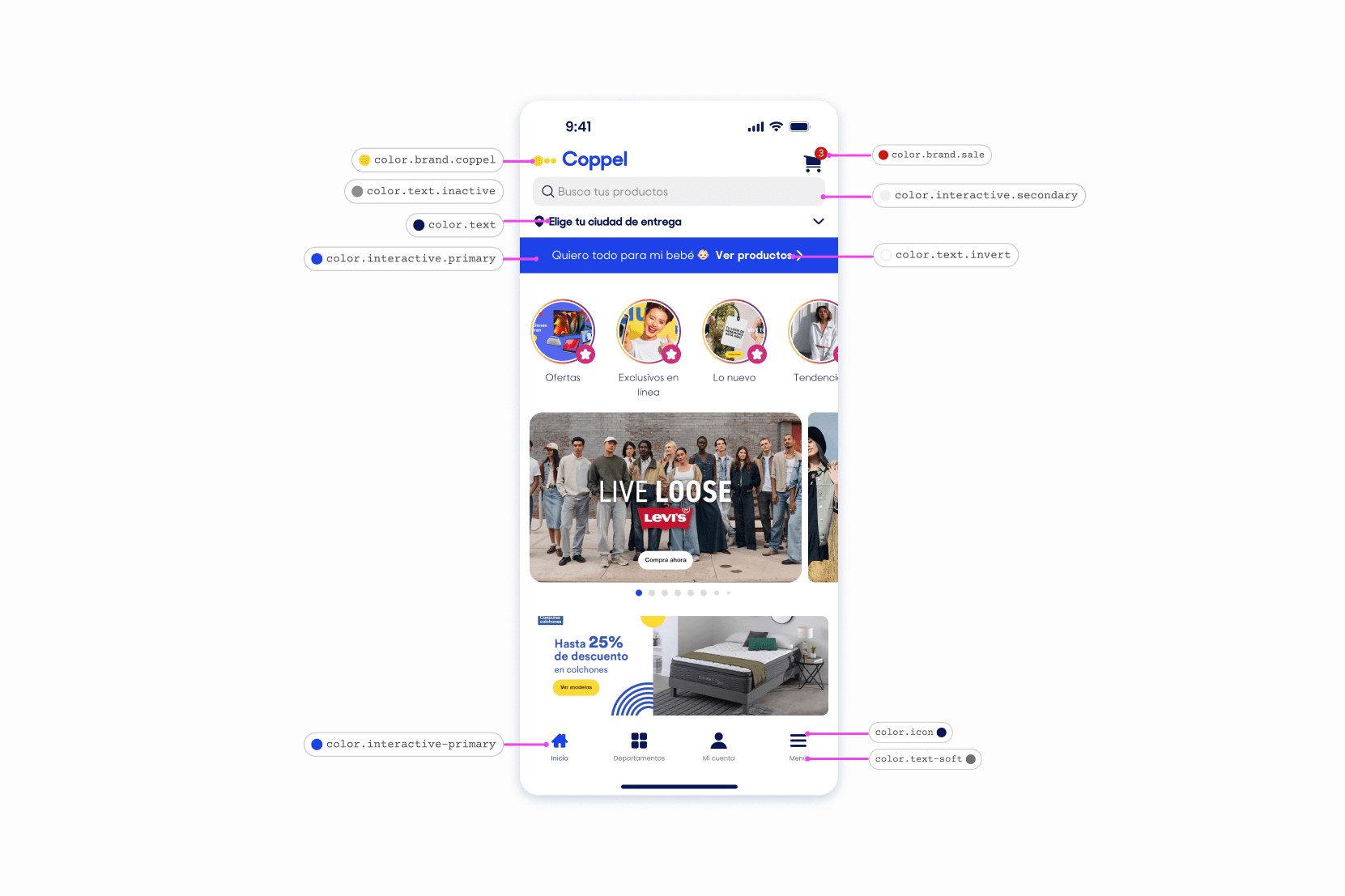
The rebrand introduced more expressive brand colors, many of which did not meet contrast requirements for accessible text.
The decision was to preserve the brand visual language while introducing specific semantic tokens for accessible text.
Accessibility was embedded at the foundation level, preventing future rework and reducing risk during the rebrand rollout.
From this new base:
My role was not to execute all components, but to define the system, establish the process, mentor and upskill designers, and ensure quality and adoption across teams.
Component reuse generated measurable operational efficiency. Based on conservative internal references, this represents tens of thousands of design hours avoided, equivalent to approximately MXN 6.7M in design effort, using average internal costs.
Coltrane Bubble became the foundation for Coppel's digital rebrand and future products, while Legacy ensured continuity through a controlled transition.
This project consolidated my role as Principal of Foundations, focused on clarity, risk reduction, and long term scalability.